

Cincinnati
Children's
Hospital
Co-op | Fall 2020
Research + Strategy
User Experience Design
The clinical paradigm of Sickle Cell Disease (SCD) has changed dramatically over the past 20-30 years, while the available educational material has not.
Cincinnati Children's Hospital Medical Center (CCHMC) tasked our team of three to develop a strategy to expand access to all educational materials.
Note : SCD is an inherited blood disorder that affects red blood cells in the body. The red blood cells can become stiff and "sickle" shaped and become clumped / stuck in the arteries causing pain and other more severe complications.

OVERVIEW
Kicking Off
During our first meeting with the CCHMC team, we framed the problem and listened to their priorities for the project. We created a priority, pain point, and personal dream board for the project (shown below) and asked each stakeholder to contribute their own thoughts.

PHASE ONE : RESEARCH
Research Methods
PRIMARY RESEARCH
-
Interviews | Hour long video and phone interviews with patient families and members of the care team.
-
Journey Mapping | Translating the patient family’s journey into a visual timeline, showing where they needed the most support.
-
Educational Ecosystems | Using qualitative data to see which resources are the most utilized by the current patient population.
SECONDARY RESEARCH
-
Literature Review | Educational materials provided by the client.
-
Benchmarking | Competitive and non-competitive benchmarking.
-
Personas | Development across a matrix of factors based on interviews.
PRIMARY RESEARCH
Interviews
Patient Family Interview Goals | Insight on their experience, what materials and resources they use, and understanding methods for how they learn best.
Stakeholder Interview Goals | Provide insight on how things operate, their
interactions with patients and families, and how they utilize different resources.


PRIMARY RESEARCH
Journey Mapping
This graph maps the level of support from the care team that the patient family receives from birth to age 10. Our goal was to see where patient families needed the most intervention on educational materials. Mapping this information informed our team that there is a high need for support from birth to age 3-4, meaning our materials should serve this time frame.
PRIMARY RESEARCH
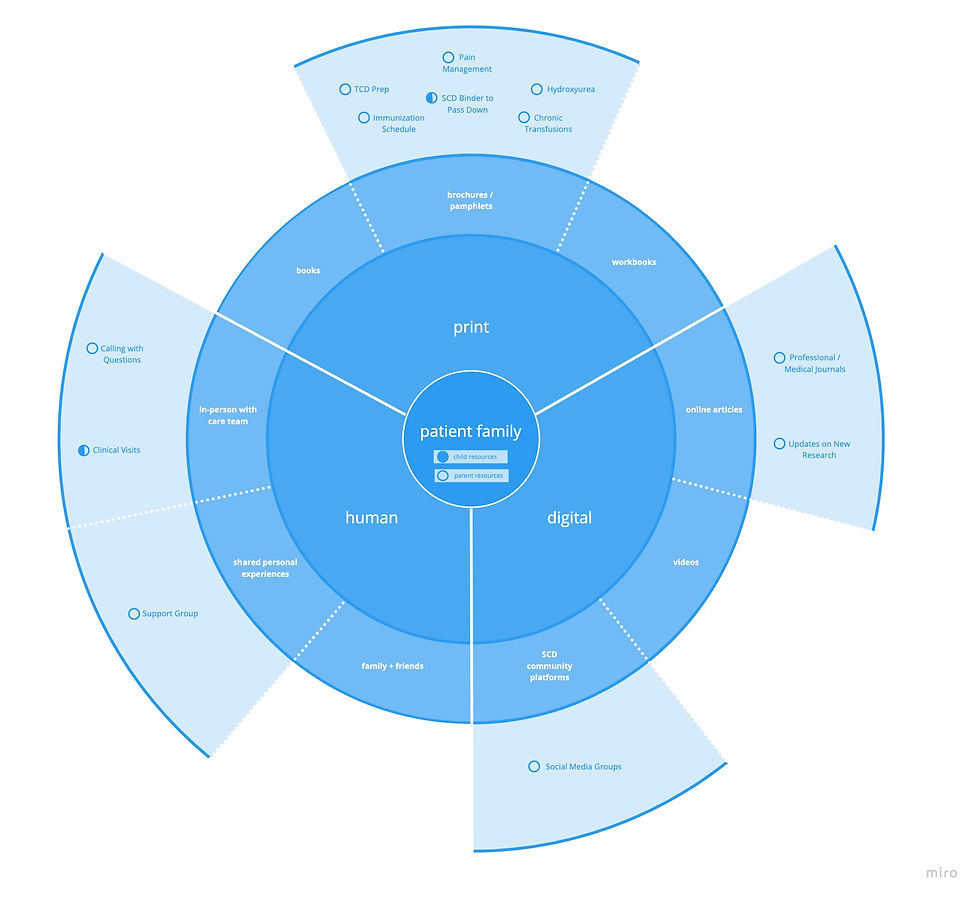
Educational Ecosystem
Below is a map of the educational ecosystem based on patient family interviews.
This shows what resources (human, digital, or print) are most commonly used by the patient population.
Based on these findings, we saw a huge connection to the human / community
element (i.e. finding support through friends + family and learning through other's experiences) followed by digitally finding information.


PRIMARY RESEARCH
Insights


SECONDARY RESEARCH
Literature Review + Benchmarking
Based on what we found during benchmarking, the most widely available resources are:
+ In-person care visits
+ Online articles
+ Brochures and pamphlets
How might we build an ecosystem that makes
the most successful resources accessible to all?
SECONDARY RESEARCH

Insights
PHASE TWO : IDEATION
Ideation Methods
-
Co-Creation | Session with stakeholders to kick-off ideation.
-
Internal Ideation | Used the S.I.T. technique to push concepts further as a team.
-
Feedback Interviews | Hour long video interviews that included feedback on aspects of the concepts.
-
Mapping Needs | Synthesized quotes and comments to find core themes.
-
Concept Surveys | Gathered feedback on concept value from stakeholders.

IDEATION
Co-Creation + Internal Ideation Sessions
After our research report-out, we conducted a brainstorming activity with the CCHMC team where we ideated potential solutions to each of the three resource types.
Our team continued this with internal ideation sessions using the S.I.T. technique to push further into each solution space.
IDEATION
Narrowing Down Concepts


IDEATION
Mapping Needs
At this point, we wanted to take a minute to ensure we were solving the needs that were initially presented to us during the research phase.
We decided to synthesize quotes and comments into categories where we saw themes develop from interview with both stakeholders and patient families. This helped us identify which concepts were meeting core needs.


IDEATION
Final Suite
Eventually, the concepts were narrowed down to 3 deliverables that would create an accessible suite
of educational materials.
FINAL DELIVERABLES
Enriching the
Educational Ecosystem
To protect confidentiality agreements, the final solutions cannot be detailed
publicly. If needed, final deliverables can be walked through during an interview.
As a suite, these concepts fulfill our initial goals of developing a strategy to expand access to educational resources around SCD.
With resources fulfilling a print, digital, and human component, our team enriched the educational space from all angles and created a type of learning method for everyone in the patient population.