top of page
dala

dala

Process

Senior Capstone Project


User Research

UX / UI Design

Centered around childhood trauma and using dissociation as a coping mechanism, I ask the question, "How can we help children safely process a traumatic memory?". 

Scroll down to see in-depth, in-the-moment, research along with blog posts dating back to June 2020 detailing how this project has evolved. 
1200x630wz.png

SECONDARY RESEARCH

Reading The Body Keeps the Score

This book has been a key resource in framing the problem around childhood trauma and the effects it has on the memory. I plan on utilizing the techniques it provides for processing trauma in whatever I decide to create. 


Key Insights: 

  • Mindfulness, Movement, Rhythms, and Action | All of
    these things are important to incorporate regularly to help
    calm the nervous system. The power of being in rhythm with others allows emotions to come to the surface. It is safe to express when surrounding by others doing the same. 

  • Processing Emotions | It is so important to address your feelings about an event. A memory is not complete until feelings are attached to it.

  • Understanding your Strengths and Resiliency | Knowing that you can rely on yourself and trust your judgement is integral to healing after trauma. 

  • Emotional Regulation | You need to feel safe and emotionally regulated before beginning to process emotions. ​

  • Traumatic Memory | Retaining memories is so complex and is even more so surrounding traumatic situations. You don't always have to have the memories to begin the healing. 


thebodykeepsthescore_quote.jpg
primaryresearch_interviews.jpg

PRIMARY RESEARCH

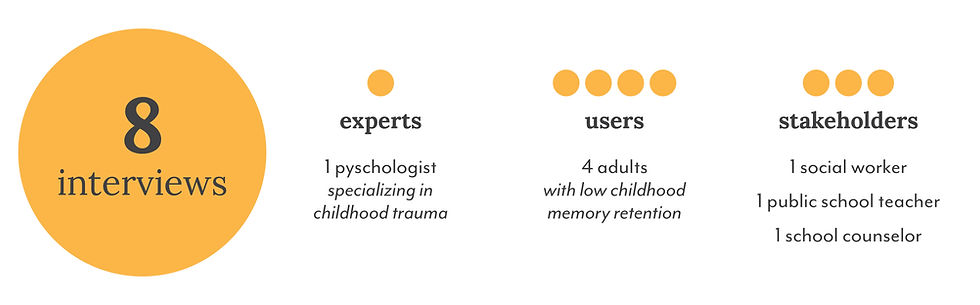
Interviews | Key Insights

EXPERT

USER

STAKEHOLDER

EMDR was repeatedly mentioned as a form of therapy to help process traumatic. I thought this was interesting because it steered away from normal talk or exposure therapy as the only source of healing from traumatic events. 


Some of the users I talked to retained memory of some sort of methodical activity from their childhood that helped calm them down and process memories. I really liked this idea of doing something so repetitively that you start to meditate and process your reality from the day. 


There needs to be an awareness that sometimes the trauma is in association with the parent, which can cause guilt and fear around starting a conversation that ultimately be healing. This also means that the parent cannot always be there to guide the child through something, which is something I should keep in mind for whatever activity I create. 

primaryresearch_survey.jpg

PRIMARY RESEARCH

Survey Takeaways

Even though some children didn't feel emotionally safe with a caregiver while growing up, it didn’t necessarily mean they weren't able to retain their
childhood memories. 


Trauma doesn’t directly correlate to memory loss.


Memory retention is so much more complicated than all or nothing. Some moments of trauma sear every detail into the brain, while others leave it empty and pushed away. To focus this project solely on memory retention would be ignoring the complexity of trauma. 

TURNING POINT

Memory Retention vs. Processing Emotion


I started my project by looking into how dissociation specifically can affect childhood memories. But now I feel like I have to make a decision... 
 

Is my goal to help childhood memory retention or help 
children process traumatic events? 

Synthesizing my survey results made me realize these two 
end goals are not mutually exclusive as I had previously thought. Similarly, 
after reading The Body Keeps the Score, I learned that healing is not necessarily about remembering what happened to you, but processing what you know. 


The better path for this project is to help children deal with (process) their trauma productively; asking them about their emotions and giving them positive coping strategies. This isn’t about targeting dissociation specifically, this is about targeting trauma.

hover for information
Final Product
dala

dala

29 Mar. - 4 Apr. 2021


The end of the semester is finally in view. I can feel the slow transition from "revision – feedback – revision – feedback" to final deliverables. With my user testing complete and feedback revisions finalized, I'm starting to visualize how to best showcase my project as a whole.


As far as I've come, I don't want to forget about the beginning. How I started with research on dissociation and memory retention, slowly moving to trauma processing, and seeing the pattern of methodical movement show up in my research. That I put all of the information I had gathered together to create something that I had never seen before. How my content came from different places but somehow all collided together at the right times to move me to my next conclusion or question. I feel like all of that is the creme de la creme and I don't want my final product to overshadow the research and strategy that created the recipe.


I love the research – I constantly want to be in the throes of it. I know how easily insights can be overlooked, but that is where I find my creative energy flowing the most. Empathizing with the user, listening to personal experiences, and strategically seeing how design can make a difference lives in the research. So, with all that being said, I still want my deliverable to speak to all those notions, those deep, complex, paradoxical research notions. Now, I just have to figure out how to present it.


As for this past week, I was also working on something that brings me joy – prototyping. Working in XD, I was able to finalize interactions and see how design elements might flow between each other. I still have a few interactions left to go, but I see myself having a complete walkthrough by the end of the week.


I've always found prototyping to be really relaxing and I find a lot of excitement in creating new ways for elements to move or animate. I love the way the movement + mantra frames have been able to animate fairly seamlessly and am proud to showcase this soon.


Till then – into AfterEffects for the concept video!

  • Mar 24, 2021
  • 1 min read

22 Mar. - 28 Mar. 2021


Continuing to push the UI, this week was comprised mostly of A/B testing for wireframe desirability. I tried to focus on specific interactions that I felt could be improved, so I created a 2nd version of each screen showcasing the main point of interaction.


I put both options side by side and created a survey asking users which they felt most attracted to + which were the easiest to comprehend. I felt it was important to include those questions separately, as I am interested in what is most visually appealing, but not at the cost of comprehension.


Home Screen | Attraction : 54% option 2 | Comprehension : 54% option 2


Identifying Emotions | Attraction : 70% option 1 | Comprehension : 70% option 2


Choosing Intensity | Attraction : 62% option 1 | Comprehension : 85% option 2


Scrolling through Past Activities | Attraction : 92% option 1 | Comprehension : 85% option 1


This week I will work on taking the feedback from the desirability testing, finalizing the wireframes, and begin the support fun part of creating interactions in Adobe XD.


Along with the user testing, I also completed a storyboard + script for the concept video I will be creating. This is my main deliverable as this will go into the importance of integrating trauma, the effects of methodical movement, and a full demo walkthrough of the prototype.


Below are the storyboard sketches:


Off to refining, finalizing, + interactions!

  • Mar 18, 2021
  • 1 min read

15 Mar. - 21 Mar. 2021


A week well spent revising wireframes based on feedback from my user testing. After visualizing my user feedback, I was able to easily see confusing points in the flow and places where inclusion could be expanded.


I was able to update my initial storyboard with new wireframes along with creating two new storyboards for my remaining personas. These storyboards were valuable to show the "immediate grounding" option and the onboarding flow.


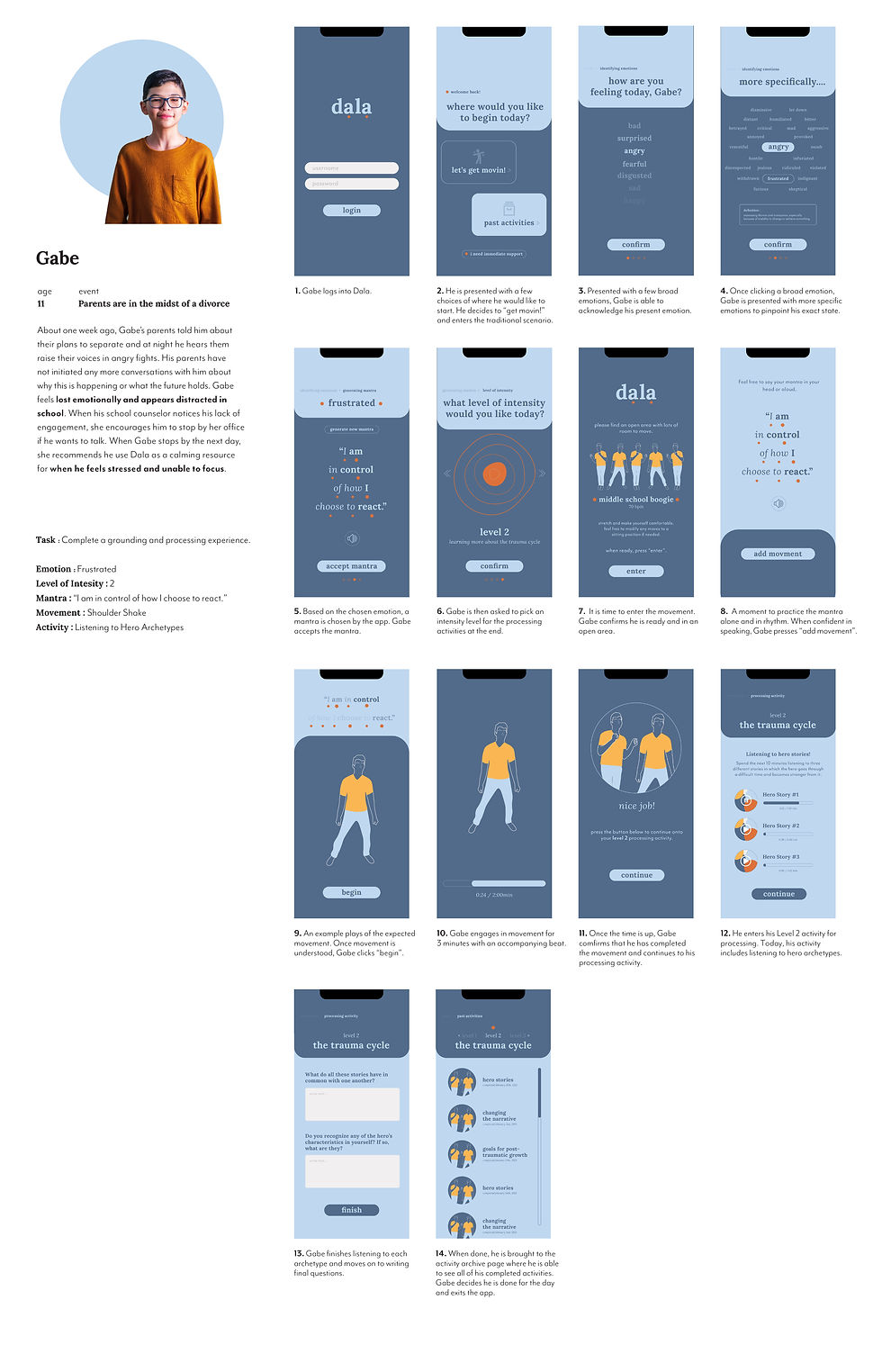
Below are the 3 personas with their storyboards:


Along with new storyboards came an updated information architecture. Shown below, the flow was updated to show the 3 separate entry points when entering the app.


I struggled this past week with knowing which pathway would be best to try next for user testing. Part of me wanted to do a "proof of concept" user testing in which 5 users would do the movement + activity for 5 days to evaluate their grounding and integration experience. After mulling this over, I realized it was almost too late for this kind of testing, considering most of the feedback I would have been receiving would not have been able to be implemented at this point in the process.


Instead, I am considering desirability user testing on specific wireframes with an A/B format. This would give me feedback that could be refined with the amount of time remaining. Along with one last bout of user testing, I am starting to look at final deliverables. This coming week I will be focused on creating a more robust storyboard for the explanatory motion piece and starting to create interactions in XD.


Till then!


  • White LinkedIn Icon
  • White Instagram Icon

Callie J Spears 2023

bottom of page