top of page
dala

dala

Process

Senior Capstone Project


User Research

UX / UI Design

Centered around childhood trauma and using dissociation as a coping mechanism, I ask the question, "How can we help children safely process a traumatic memory?". 

Scroll down to see in-depth, in-the-moment, research along with blog posts dating back to June 2020 detailing how this project has evolved. 
1200x630wz.png

SECONDARY RESEARCH

Reading The Body Keeps the Score

This book has been a key resource in framing the problem around childhood trauma and the effects it has on the memory. I plan on utilizing the techniques it provides for processing trauma in whatever I decide to create. 


Key Insights: 

  • Mindfulness, Movement, Rhythms, and Action | All of
    these things are important to incorporate regularly to help
    calm the nervous system. The power of being in rhythm with others allows emotions to come to the surface. It is safe to express when surrounding by others doing the same. 

  • Processing Emotions | It is so important to address your feelings about an event. A memory is not complete until feelings are attached to it.

  • Understanding your Strengths and Resiliency | Knowing that you can rely on yourself and trust your judgement is integral to healing after trauma. 

  • Emotional Regulation | You need to feel safe and emotionally regulated before beginning to process emotions. ​

  • Traumatic Memory | Retaining memories is so complex and is even more so surrounding traumatic situations. You don't always have to have the memories to begin the healing. 


thebodykeepsthescore_quote.jpg
primaryresearch_interviews.jpg

PRIMARY RESEARCH

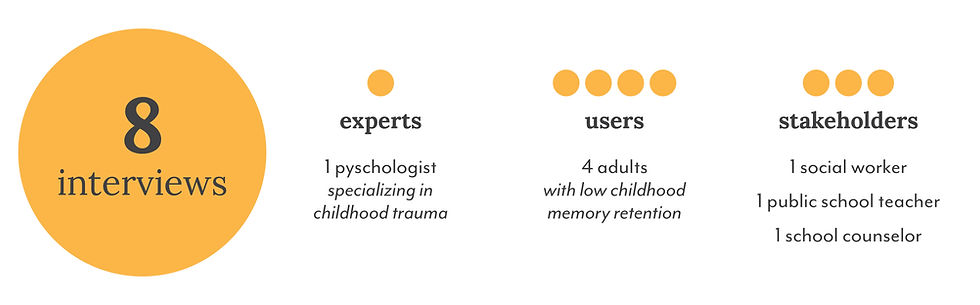
Interviews | Key Insights

EXPERT

USER

STAKEHOLDER

EMDR was repeatedly mentioned as a form of therapy to help process traumatic. I thought this was interesting because it steered away from normal talk or exposure therapy as the only source of healing from traumatic events. 


Some of the users I talked to retained memory of some sort of methodical activity from their childhood that helped calm them down and process memories. I really liked this idea of doing something so repetitively that you start to meditate and process your reality from the day. 


There needs to be an awareness that sometimes the trauma is in association with the parent, which can cause guilt and fear around starting a conversation that ultimately be healing. This also means that the parent cannot always be there to guide the child through something, which is something I should keep in mind for whatever activity I create. 

primaryresearch_survey.jpg

PRIMARY RESEARCH

Survey Takeaways

Even though some children didn't feel emotionally safe with a caregiver while growing up, it didn’t necessarily mean they weren't able to retain their
childhood memories. 


Trauma doesn’t directly correlate to memory loss.


Memory retention is so much more complicated than all or nothing. Some moments of trauma sear every detail into the brain, while others leave it empty and pushed away. To focus this project solely on memory retention would be ignoring the complexity of trauma. 

TURNING POINT

Memory Retention vs. Processing Emotion


I started my project by looking into how dissociation specifically can affect childhood memories. But now I feel like I have to make a decision... 
 

Is my goal to help childhood memory retention or help 
children process traumatic events? 

Synthesizing my survey results made me realize these two 
end goals are not mutually exclusive as I had previously thought. Similarly, 
after reading The Body Keeps the Score, I learned that healing is not necessarily about remembering what happened to you, but processing what you know. 


The better path for this project is to help children deal with (process) their trauma productively; asking them about their emotions and giving them positive coping strategies. This isn’t about targeting dissociation specifically, this is about targeting trauma.

hover for information
Final Product
dala

dala

  • Mar 10, 2021
  • 2 min read

8 Mar. - 14 Mar. 2021


The first functional prototype of dala is underway! This past week I made huge strides in finalizing UI elements and getting feedback. Not only was I able to create a functional prototype, but I was able to conduct user testing on 8 individuals.


Conducted fully remotely, I asked users to complete the task of going through onboarding, personalizing your movement, and finishing their movement in dala. I noted they would know when they are done when they see the screen that says “nice job”.


Below are some screenshots from Adobe XD, the software I used to create the prototype.


Utilizing the timer function for interactions, I was able to create an animation of the movement expected from the user. This was integral to my user testing as this helped me gauge things such as if they could follow both the movement and the mantra simultaneously, along with how they felt about the timeframe of 3 minutes.


After testing out the prototype, I asked them to answer some questions about their experience and comprehension in the app. Questions included:

  • Did you understand the purpose / functionality of the app after the onboarding introduction? If not, what was confusing?

  • Were you able to follow along with the movement + mantra? Explain.

  • Did you feel grounded (relaxed, present, ready to participate) after the movement? Explain.

  • Overall: What points during the prototype did you feel confused? (i.e. didn’t know what was happening or didn’t know where to click next)


Some of the majors changes I saw through this testing were:

  • defining terms (i.e. processing activity, trauma cycle, etc.)

  • adding a progress bar during the movement section

  • adding beats or ticking noises during movement

  • showing how to navigate intensity circles (UI element)

  • re-thinking aspects about the movement + mantra (should there be points to work up to? can someone be only saying the mantra if they don't want to include movement? etc.)


Moving forward, I look to incorporate this feedback into the current wireframes along with conducting long-term user testing to answer more questions about the prototype. Does this have long-term effects? How does the movement feel paired with the processing activity? Did you see growth in the integration of your trauma?


By next post, I hope to have a long-term user testing format already underway!

  • Mar 3, 2021
  • 1 min read

1 Mar. - 7 Mar. 2021


Busy, busy week and in the middle of a lot of updates. This past week was focused on visuals (UI moodboard, finalizing brand identity, and updating wireframes). Below is the brand identity toolkit – helping me solidify my color palette, type and a new wordmark:


While revising the wireframes from last week's feedback, I began to focus on illustrating the dance moves. Taking photos of one of my roommates, I was able to trace an outline of him doing a few movements. Putting them all together created a fun stop-motion that could be used under the "example movement" section of the app.


Below is a quick gif of my progress:


After realizing that these illustrations would work and help someone mimick the movements in real life, I moved on to color + style explorations. Still in the midst of deciding, below are some options I have been playing with:


With next week around the corner, I'm creating a fully-functional prototype to user test the onboarding and movement instructions – let's get movin'!

  • Feb 24, 2021
  • 1 min read

22 Feb. - 28 Feb. 2021


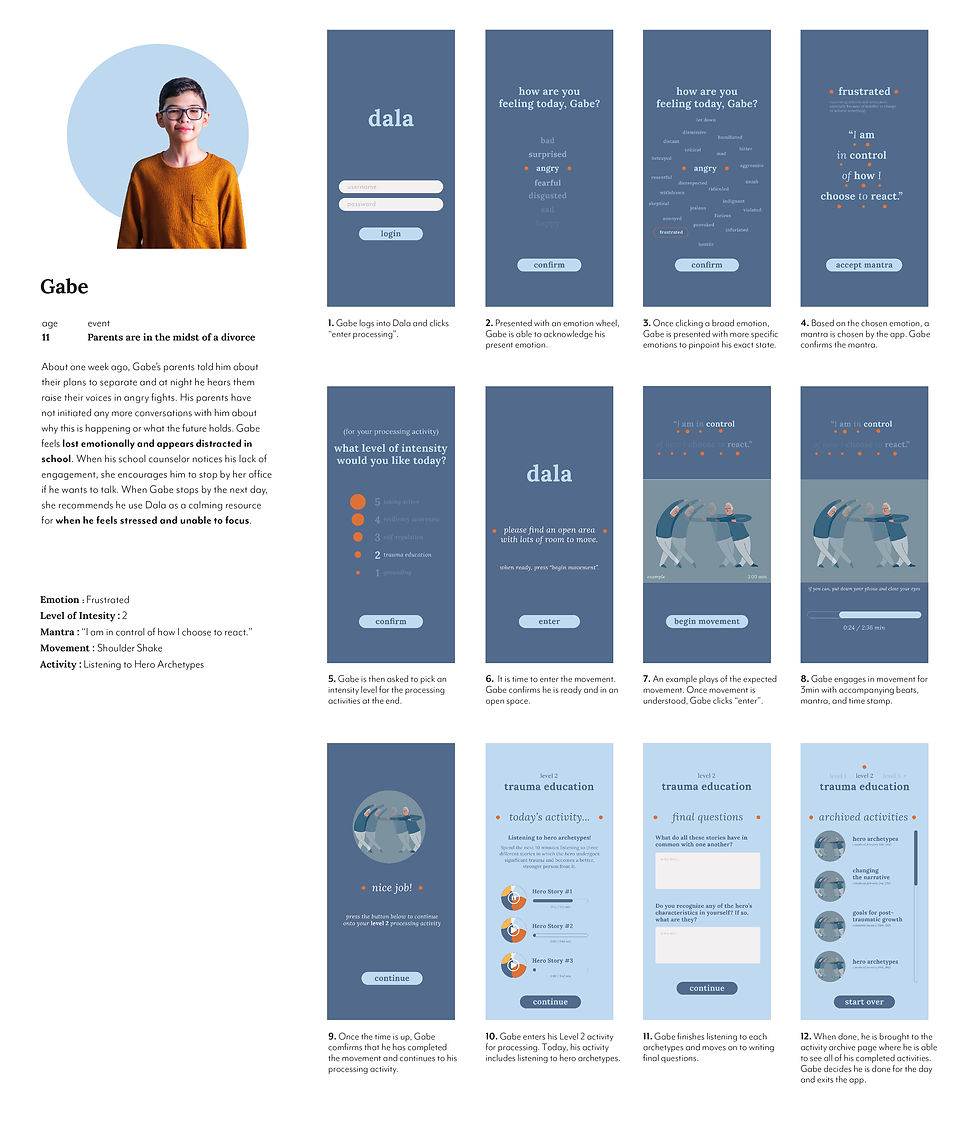
This past week focused on finalizing the user journey. I finalized a storyboard for one of my personas and worked through visuals for initial wireframes (see below):

Note : The dance illustrations are not my own (only used as placeholder).


Visually, my hardest development was how to keep the imagery / UI elements at a pre-teen level (ages 10-15), while not creating something that would feel childish or demeaning to the age group. I decided to focus on the following criteria: keeping the elements stylized, attention-grabbing + keeping, visual (not text heavy), and very open (lots of white space). Below is some imagery I plan on using as inspiration for future UI development.


  • White LinkedIn Icon
  • White Instagram Icon

Callie J Spears 2023

bottom of page