



- Jan 27, 2021
- 2 min read
25 Jan. - 31 Jan. 2021

Trauma, when not processed, continues to grow and expand. It manifests itself in addictions, unhealthy coping mechanisms, and the denial of reality. The graphic above shows how the specific point of trauma is hardly ever the end of the experience.
This past week, I focused on the typical journey of the user before and after a traumatic event. With information found from Expressive Trauma Integration (ETI) led by Dr. Odelya Gertel Kraybill, undergoing a traumatic event can be sorted into 6 stages.
Routine : Life before trauma.
The Event : The traumatic event takes place.
Withdrawal : This stage can be the longest + hardest. One withdraws from the world as a survival strategy, cycling through many emotions with an overall feeling of instability.
Awareness : One becomes aware of the dynamics of what has happened to them and has a sense of self + context.
Action : Deciding to take action and explore different coping mechanisms.
Integration : One has the ability to reflect on their trauma while acknowledging personal strengths needed to survive.
My concept will be focusing on getting users from stage 3 to stage 6. Helping children / teens with the hardships of withdraw, guiding them through awareness + action, and integrating the traumatic event into their lives as a source of resilience and strength.

This coming week will be focused on brainstorming for each point of intervention. By utilizing matrices and categories of the integration framework, I am hoping to find the best points of intersection between something that will be usable for children / teens and seamless to their current lifestyle.
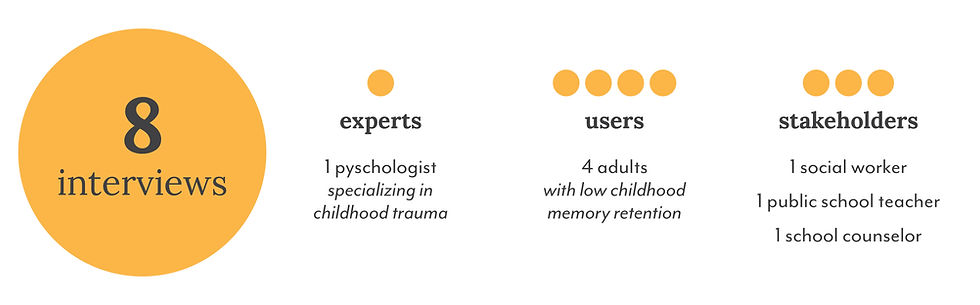
To ease ideation, I have decided that my setting for this resource will be inside public schools. I came to this decision because of the interviews I did in the research phase. As I interviewed both a school counselor and a teacher at a trauma-informed public school, I saw the impact they had on their students and the potential to be their trusted adult in times of hardship.
During my interview with the school counselor, she mentioned how sometimes students didn't feel comfortable talking to their caregivers about traumatic events because they may have unconsciously or consciously been the cause of this trauma. Because of this, the caregiver might not be receptive to the child's feelings or feel guilt for playing a part in their child's trauma (causing the child to also feel guilt/shame for bringing it up).
With the school as the point of introduction for this resource, it remains neutral ground for processing and eliminates the need for caregiver buy-in. This decision sets a firm stakeholder in which I can also refer back to during the ideation phase.
That's all for this week, onto the next!

